
To talk about animation in Slovakia means, almost inevitably, turning one’s gaze back to the former Czechoslovakia, a territory whose audiovisual tradition has shaped a large part of the European animated imaginary. A singular aesthetic sensibility was forged there: artisanal in its execution, profoundly experimental in its form, and, above all, capable of turning fantasy into a mirror of the human condition. In Latin America, we usually approach that lineage through figures like Jiří Trnka or Jan Švankmajer, but upon arriving in Slovakia, I understood that this legacy does not belong solely to the past; it continues to transform, mutate, finding new routes in the hands of a generation that sees animation as a living language.
My own connection with animation began precisely with Švankmajer, with that universe where the tactile coexists with the unsettling and where imagination is not a childhood refuge, but a political territory. That discovery marked me deeply: I understood that, in this part of Europe, animation and its derivations—including VFX—do not operate only in the realm of artifice, but in that place where the symbolic confronts the real. There is, in many of these works, a persistent question about what it means to be human: about our desires, about shared fears, about what binds us together as a collective. The social, historical, and political context is not hidden; rather, it filters into the very texture of the images.
Perhaps that is why I was interested in observing how animation is currently conceived in Slovakia. I found an approach that favors silence, that treats the intimate as a field of investigation, that trusts that an image can say what language sometimes fails to name. This sensibility appears strongly in the works of Vladimir’s students. In their short films, one notes a meticulousness bordering on the obsessive, but not as a technical display, but as a way of cultivating emotion. The details do not function as ornaments, but as resonances: extensions of the characters, modulations of an inner world that needs to materialize to be understood.
What surprised me especially is how, here, animation and VFX function as tools for profound thought; poetic and political devices capable of engaging with modernity without sacrificing the emotional depth or the critical vocation that characterize this region. These are images that open up to the contemporary, but which do not renounce their root: that tradition which understands fantasy not as evasion, but as reflective power.
In this context, talking with Vladimir Mrkvica, a visual effects professor in Bratislava, is fundamental to understanding how this heritage shifts into the present. His practice—marked by technical curiosity, the construction of his own universes, and a careful reading of the social role of VFX—allows one to consider the current state of a field where the imaginary and the political constantly intersect.
Following is the complete interview: a journey through his processes, his ways of expanding reality through digital images, and his reflections on the future of VFX, on the capacity animation has to challenge our time, and on the need—so human—to invent worlds when our own falls short.
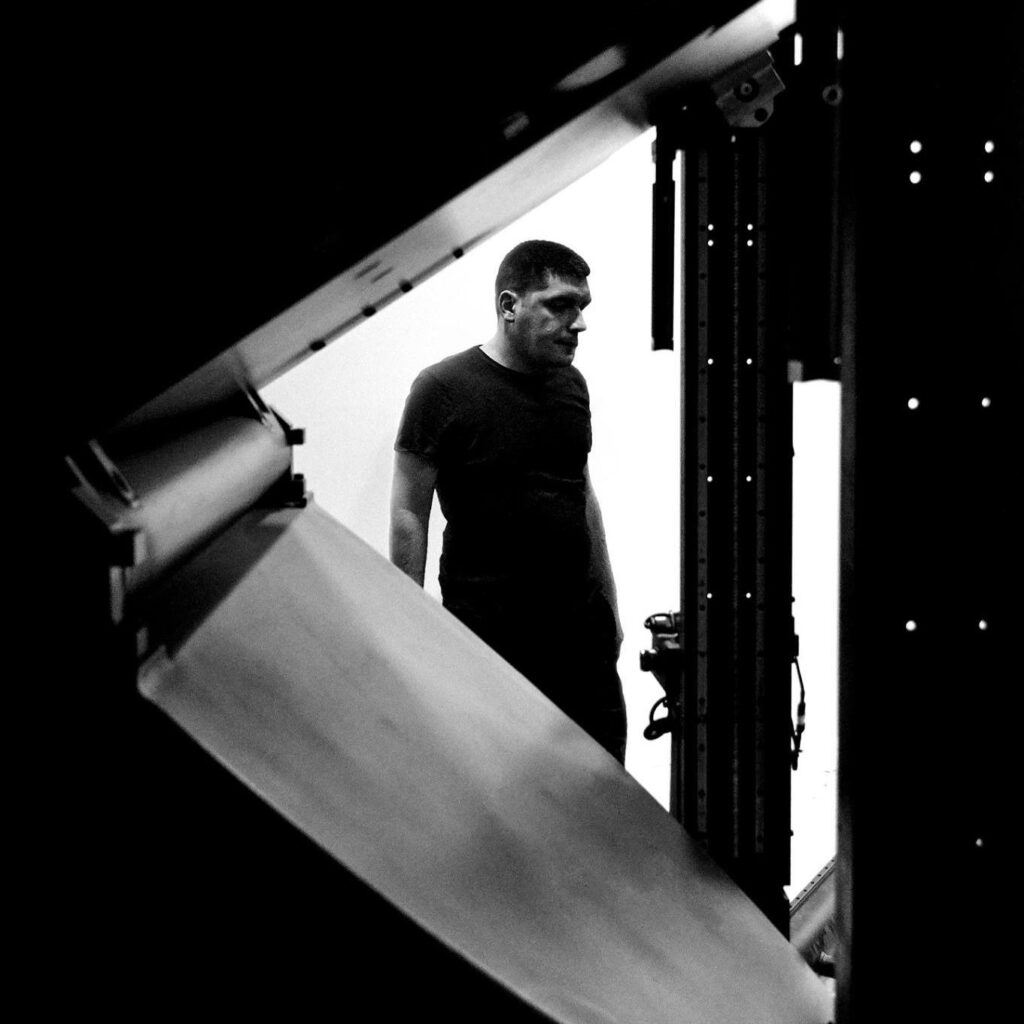
N: What led me to specialise in VFX?
V: From an early age, I was fascinated by the idea of seeing things that were invisible to the eye. I was shaped by my childhood imaginations and by watching the first sci-fi movies on VHS. During my first attempts to make a film, I faced some challenges due to a zero budget. However, I found that it is cheaper to make a burning helicopter on the computer than in reality. At the same time, I was discovering new possibilities for narratives when, as an avid video game player, I edited my first videos with VFX. I always wanted to enrich the given image, whether filmed or recorded from the game, with elements that helped to express the emotions that I wanted to achieve in the audience. At the same time, I found the current reality predictable, boring, so I created my own! The world of CGI is an amazing place where anything is possible. It’s up to you where you go and there are no limits.
N: Describe VFX creation for films or projects?
V: During my university studies, I had the amazing opportunity to create all of my assignments and films with original subject matter. When you invent a story that isn’t anchored in any way, you get to be the architect of a whole new universe. Everything has to work together for the viewer to believe it. Therefore, the first step is always to dive deep and study the given issue, looking for textual and image references. From this, you can later assemble a mosaic of elements that will be exposed in your work. The moment I have a grasp of the whole topic, I move into the planning and production of the VFX part. Regardless of the medium, I try to have the number of shots, their length and content clarified as soon as possible. The budget, timing, division of work between artists depends on this, and it’s all part of the fun! As a VFX supervisor, I am currently more focused on the creation process in VFX production. I love the challenge of streamlining the work needed to achieve the desired result. Despite the fact that the field of VFX is a demanding technical-aesthetic science that requires tens of thousands of hours of learning and practice, I approach it with ease. If we focus on something for too long, we are probably doing it wrong.
N: Work environment in Bratislava vs other locations? Rest of Slovakia / world.
V: While the Slovakian VFX market might be relatively small, it’s still booming. With a few hundred VFX artists at most, the city is home to the majority of the country’s VFX professionals. And it’s not just about quantity — the quality is there too. Many VFX artists go to the Czech Republic for two larger studios, but there’s no need to leave Bratislava. The city is home to a few VFX studios of its own, offering a great opportunity for artists to gain experience and grow their skills. These studios often serve as an intermediate step and a ticket to world-class VFX studios such as ILM, MPC, Weta and the like. In Slovakia, there is currently a good ratio between the quality of VFX artists and the cost of living, thus also their price. That is why people living in Slovakia are an extremely interesting proposition for the foreign market.
N: What tools and software do I use in my daily work?
V: So far, I’ve had the pleasure of working with over 30 programs in the field of VFX. For creating product videos, I primarily use Cinema 4D + Redshift and the Adobe package, but on a monthly basis, I come across at least ten other programs that need to be used for specific tasks. I don’t pay too much attention to the programs themselves, but I love exploring new ones. Each of these programs has detailed documentation, and there are also excellent paid courses that you can take to learn them in a few days or weeks. It’s important to remember that you’re not limited by the possibilities of the program in what you want to get on the screen, and that you should never change your original intention. Software is just a tool.
N: What was the most challenging project and how did I approach it?
V: My Master’s film, which I directed, is definitely among the most challenging projects I’ve ever worked on. It was a real learning curve for me, as almost 70 people were working on this project at one point and considerable funds were invested in it. It was a fantastic opportunity to learn how to lead people and make important decisions. Especially if you are under such pressure as a student. My good friend, a talented photographer who moved to Ecuador, also worked on this project. I then had the incredible opportunity to work on the most challenging project for a few years after finishing school. As it is under NDA, I can only say that it was a music video for a very famous artist from the USA. The project was extremely demanding, each scene had about 15-20 rounds of feedback, but it was so rewarding! In just a month, I produced four minutes of full CG content, working 500 hours in total. I ended up in the emergency room twice, but it got a staff pick on Vimeo!
N: How do I work with the art director and production designers to make the VFX work as well as possible?
V: As a teacher of the history of visual effects at a university, I love using techniques from the past, which were often based on sets and on set props. I’m not a fan of the figure in the middle of the green room, but I’m sure we can make it work. Once I have the subject in hand, I get in touch with the production designers, art directors, costume designers, etc. as soon as possible to get them involved in the filmmaking process. Their knowledge helps the film develop and the script, not only in the final scene. Nathan Crowley, the production designer of Dunkirk, gave an excellent lecture about it at our university.
N: What exciting new trends in VFX are we going to see?
V: We are now at the end of the library era. When I started with 3D, I made every element of the scene myself. Currently, there are hundreds of markets where 3D scans of almost all the objects you need to build a classic scene are available for a few dollars. The most used software for photogrammetry, RealityCapture, was created in Slovakia, so there is a strong theme here. We also produced a set of 3D trees and landscapes during the creation of our Master’s film and placed them on the market for free. They still have tens of thousands of downloads, which is a great success! It is definitely a step forward, but you have to be careful that these props are not the supporting part of the project. Such creation can be considered as generic art, but it is still a great achievement.
By far the biggest topic for the near future is the emergence of artificial intelligence in the field of visual effects. This is an exciting development! It’s incredible to see the progress being made every month. The VFX industry is going to change significantly in the coming years thanks to AI. It’s not just about typing in text and waiting for a randomly generated video. I see the use of AI in many steps in the VFX creation process. The possibilities are endless. AI can be used to get information for creating a story, collect references, create mood boards, set extensions, retouch, help animators add frames… the list goes on. While there might be some job losses, there will undoubtedly be more content created overall, and that created by VFX professionals will still have its place on the silver screen. We’ll also be able to enjoy the results of AI in short videos on social networks. As in the past, there were concerns about cinematography with the advent of digital cameras. But these concerns were quickly put to rest as digital cameras quickly became the go-to choice for many filmmakers.
I would absolutely embrace AI! It is a technology that we cannot avoid, and it is an incredible opportunity for us to define its use. As history has taught us, any technology can be used for both right and wrong purposes. It is up to us to choose the path we want to take. This year I am starting my PhD on AI and its use in VFX, so I will be exploring this topic in more depth in the coming years.
N: Could I ask your thoughts on the potential influence of VFX on politics?
V: There is a worrying trend in the world at the moment, namely the rise of autocrats. I often work with propaganda materials. You probably know where I’m going with this. We recently had parliamentary elections in Slovakia. During the moratorium, a really unsuccessful deepfake video circulated on the Internet. Despite his absurdity and poor quality, tens of thousands of people believed him. On the other hand, VFX are a powerful tool that can be used for good. They offer maximum freedom. Nothing is forbidden in VFX. If you want to protest against the government, you can create a work from home and freely put it on the Internet. You don’t need a staff, expensive technology or any other means that could prohibit or take away from you in order to present your own thoughts and opinions. In light of the current political situation in Slovakia, which is leading our country in a direction that is not entirely compatible with our values and interests, it seems that the potential for creative expression, even with limited resources, could be a valuable asset for our country. Politicians recently politicised film funding in Slovakia so I think that this freedom in VFX industry will be helpful to express an attitude in the next few years :)
N: The difference between working on VFX for film and games / advertising.
V: While the techniques used in all areas are quite similar, the primary difference is in the process. It differs from project to project, but if I were to generalise, the advertisement must always be produced quickly so that it is up-to-date and ready for the set day of the campaign launch. I have observed that creative people in this area can sometimes find it challenging to maintain their energy levels, and therefore many of them alternate full commitment with maximum rest. The time frame of VFX creation for the film is spread over a significantly longer stretch. It goes through the phases of pre-production, production and post-production of the film. Naturally, the greatest pressures are at the end of the project, when the days are counting down to the premiere. However, there are also cases when maximum quality is required for the purposes of the test audience (Marvel). In such a process, there is pressure from the beginning to the end of the project. With the advent of virtual production, it seems that a significant part of the work of visual effects artists is also moving to pre-production. I must admit that I have not yet had the opportunity to work for the game industry, but I believe that the development process there is spread over several years. However, the creation of a trailer for the game feels like weeks or months at most. It is a rather quick process.
N: What is my source of information about VFX?
V: I find artists on social networks and portals like 80lvl or iamag to be a good source of information. Individual companies on LinkedIn or various YouTubers also have interesting content. I think professional conferences, of which we have quite a few in Central Europe, are a good source of information. In addition to interesting speakers, there are also afterparties for networking. I am also the co-organizer and moderator of the VFX meetups that we do several times a year. I remember a magazine that focused on the VFX world. News about software, movies, artists .. that was one of the best source of information. I like this form of information submission and I really appreciate that you still manage to stick to it.
N: What would you advise those interested in a career in the field of visual effects development in Bratislava?
V: I would say the same to anyone interested in a career in VFX in Bratislava as I would to anyone interested in the whole world. The most important thing is to learn from the best, be patient, follow trends, movies, commercials, game trailers, and everything else that’s going on around us. It can be tough to get started in this field because you have to put in 10,000 unpaid hours, during holidays and nights, to start doing relevant freelance jobs. But it’s totally worth it! Everything you create will be your motivation, drug and reward. You’ll get to create new, unique worlds, thoughts and emotions in people all over the world. Plus, the VFX sector is financially well valued worldwide, so you’ll be able to make a good living. Not only does our university produce some amazing VFX artists, but we also have some incredible VFX creators who really know their stuff. Unlike VFX, these skills can’t be learned from an online course. In our region, there’s a huge demand for VFX artists, so we’d love to welcome you from abroad!
I am left with the feeling that the future of VFX lies not only in technical innovations or the expansion of artificial intelligence—although these will inevitably transform the field—but in the artists’ capacity to sustain that tension between the visible and the symbolic, between the real and the imagined. It is there, on that edge where the image turns into thought, that the Slovak tradition finds new ways to keep breathing.
Perhaps that is the true legacy: the insistence on creating worlds not just to escape, but to better understand our own.